
Blogging is your public “proof of work”
A blog is simply a public, searchable library of what you know: explanations, decisions, experiments, and lessons—written so other people (and now machines) can reuse them. In 2026, that matters more than ever because discovery often starts with an AI assistant summarizing the web, not with someone patiently clicking ten blue links.

From my own experiments building Blog‐O‐Bot, the posts that perform best are rarely the perfectly polished “10 tips for X” articles. The ones that get shared—and increasingly quoted—are the ones where I show up as a person: what I tried, what failed, what surprised me, what changed my mind.
That’s the quiet shift many people miss: personal experience is becoming indexable. Not as a feel-good bonus, but as a real ranking and selection signal. If an AI system has to answer “How do I choose a CRM for a small team?” it’s far more likely to pull from a page that includes trade-offs, constraints, and outcomes than from a generic template.
Daily blogging starts to make sense when you stop seeing it as homework and start seeing it as continuous evidence that you exist, you operate in a niche, and you keep learning.
The “old SEO” mindset is fading (but SEO isn’t)
If you still think SEO (Search Engine Optimization) is mainly about repeating a phrase like “best accountant in Split” fifteen times, you’re playing last decade’s meta. Today’s systems can read semantically: they infer meaning from context, structure, examples, and how well your page matches the intent behind a query.
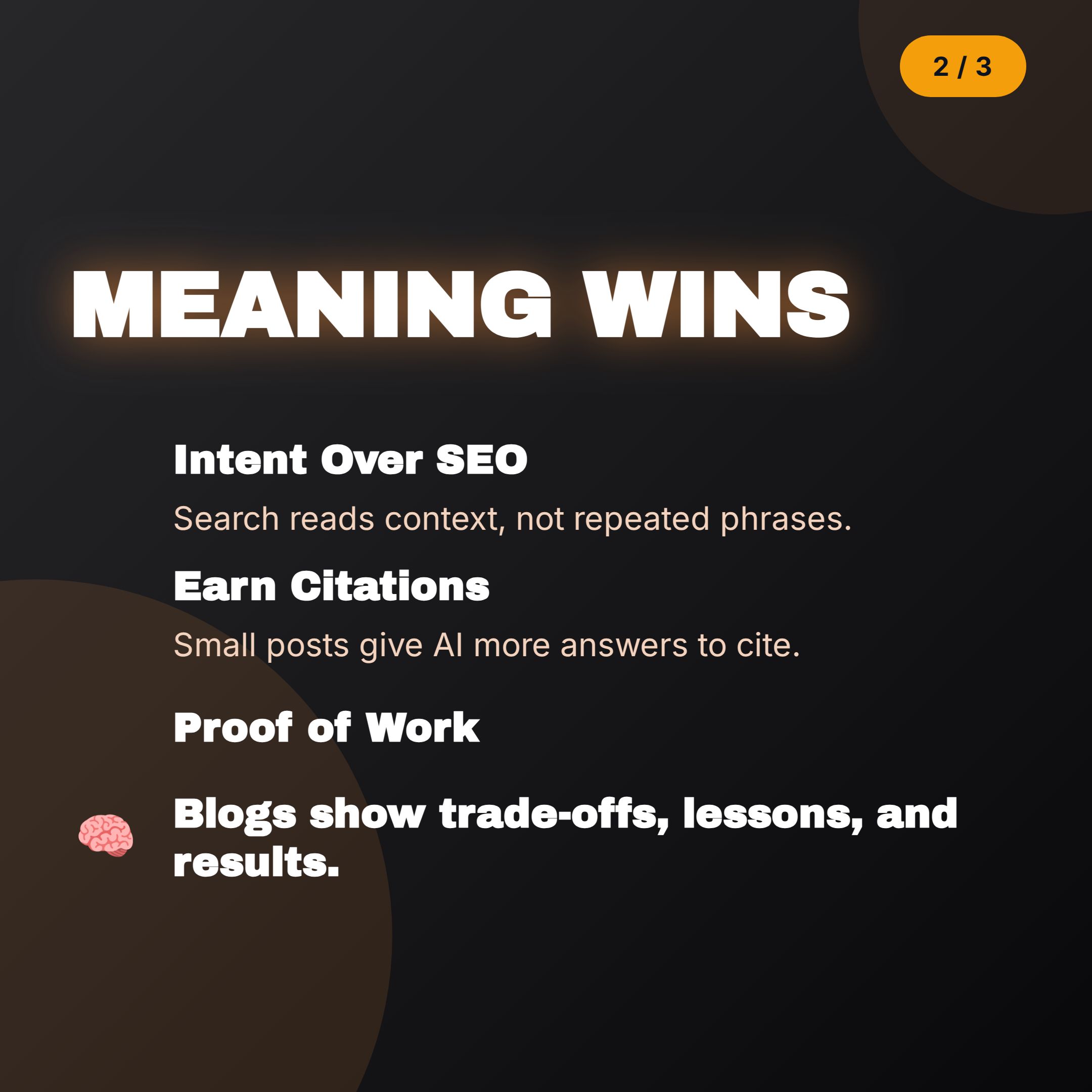
This doesn’t mean keywords are dead. It means they’re no longer the main character. Relevance and authority matter more, and both are built over time through a body of work—multiple pages that collectively signal, “This person lives and breathes this topic.”
A simple way to think about modern discovery is a two-step filter:
- Search engines decide whether your pages are worth indexing and ranking.
- AI systems scan that pool (often strongly influenced by top results) and extract the clearest, most trustworthy explanations.
If you’re invisible in traditional search, it’s unlikely you’ll suddenly be a star in AI-generated answers. So “optimizing for AI” is not a separate universe—it’s the same foundation, just with a new reader that’s faster, pickier, and more literal.
Daily blogging supports both steps at once: more pages for search engines to discover, and more context for AI to understand your expertise beyond a single landing page.
The new visibility layer: “AI citations” and why frequency helps
A metric that’s slowly emerging behind the scenes is AI citations—any time an AI assistant mentions your brand, your product, or your article as part of an answer. It’s like being quoted in a conversation you’re not physically in.
“I didn’t click a single result. ChatGPT summarized it—and one sentence referenced your blog. That’s how I found you.”
Right now there’s no universal dashboard that cleanly shows “you were cited 37 times this week.” But the direction is obvious in 2026: people ask AI, AI scans the web, and then chooses which sources are worth grounding the answer in.
Daily blogging helps here in a very specific way: it creates more “hooks.” Each post can become the best match for one narrow question:
- “What does onboarding automation actually include?”
- “How long does it take to see results from content marketing?”
- “What’s the difference between a newsletter and a blog?”
The goal isn’t to flood the internet with words. It’s to publish many small, concrete answers that AI can confidently reuse because they’re specific, consistent, and grounded in lived experience.
One practical reason daily blogging gets easier (and better) is that it forces you into a repeatable creation rhythm instead of waiting for “inspiration.” I treat writing the same way I treat building: a small ritual, a few constraints, and clear trust boundaries with AI tools so the output still sounds like me. That’s the same idea I unpack in this vibe-coding ritual for staying in flow with AI.
Authority isn’t a checklist—build it with small experiments
A myth that refuses to die is: “Good content automatically ranks.” The harsher (and more useful) reality is that good content is necessary but not sufficient. Search systems evaluate patterns: engagement, internal linking, topical depth, historical performance, and sometimes backlinks from relevant sites.
This is where E‐E‐A‐T (Experience, Expertise, Authoritativeness, Trustworthiness) gets misunderstood. People treat it like a checklist—add an author bio, sprinkle links, make the article longer—and expect rankings to flip. Those touches can help, but they don’t replace the deeper signal: do you consistently solve real problems for a specific audience?
Daily blogging fits a test-and-iterate mindset:
- Step 1: Publish fast, not perfect. A short post that answers one question beats a draft that never ships.
- Step 2: Observe behavior. If a post gets impressions but no clicks, the title might not match intent.
- Step 3: Interlink your “winners.” Point related posts to each other so both users and crawlers see a coherent topic cluster.
- Step 4: Add proof over time. Screenshots, numbers you can stand behind, before/after outcomes, and constraints you faced.

Backlinks still matter in 2026, especially in competitive spaces, but quality beats volume. One link from a relevant site with real traffic can outweigh 100 forgettable directory links.
A final note on mass AI content: the warning is valid. Generic, templated posts are easier than ever to produce—and easier than ever to ignore. The better use of AI (including in tools like mine) is to shape your real material—notes, case studies, internal docs—into consistent publishing, without erasing your voice.
If you showed up every day with something real—a lesson, a definition, a small story—what would your site look like in 90 days? And when your future customers ask an AI assistant for advice, will your experience be in the room?