
The CTR cliff is the new baseline, not a reporting glitch
The most honest SEO web chart in 2026 looks like this: 156K impressions, average position hovering around 10, and a 0.5% CTR. Visibility up, traffic flat. That’s not a freak occurrence—it’s the default for a growing slice of queries as AI Overviews, AI Mode, and “answer box” experiences expand.
If your mental model is still “rank higher → get more traffic,” you’re working from a 2019 assumption. In
many datasets we’ve reviewed at Blog-O-Bot, Google has effectively decoupled being seen from being visited. The result: more brands are “present” in search while fewer earn the click—and teams keep diagnosing it as a content problem when it’s often a SERP design problem.
The SERP is turning into a recommendation engine
What’s changing under the hype isn’t “SEO is dead,” it’s what the result page is for. Classic SERPs were a navigation layer: a curated path to the open web. AI search behaves more like a destination—users compare, shortlist, and decide without leaving.
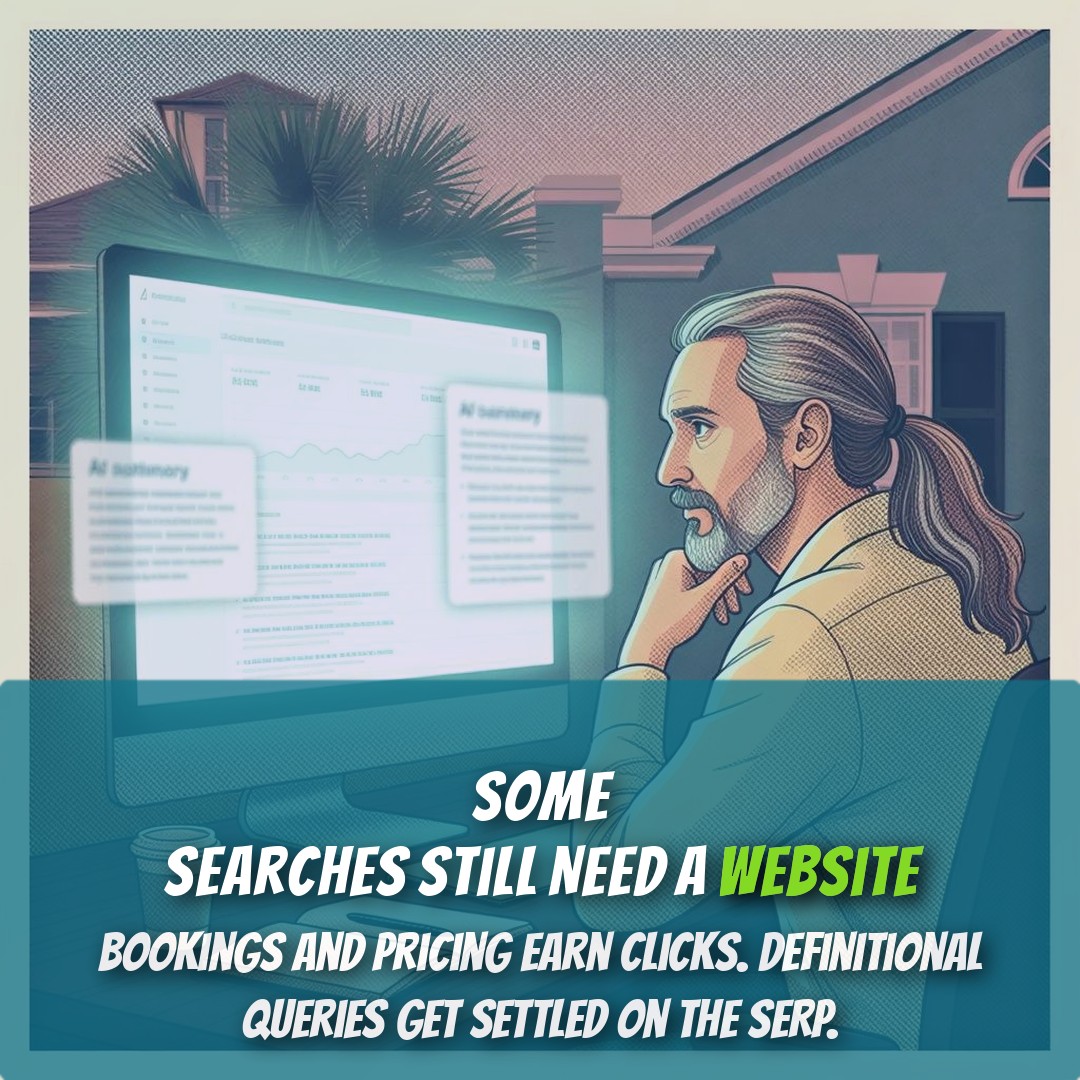
In AI Mode, people spend materially longer inside the pane than they do with AI Overviews, and they often accept the system’s shortlist rather than rebuilding it from scratch. That has a brutal implication for marketers: the “conversion event” is shifting upstream to the recommendation moment, not the website session. You can do everything “right” on-page and still lose because the query type has become structurally low-click.
The counterpoint is fair: clicks still exist. They’re just increasingly reserved for tasks that require a website—pricing, booking, compliance details, deep comparisons, and transactions.
Liability is quietly splitting SEO into two tracks
Here’s the trend most teams underreact to: Google is more willing to summarize low-risk queries than high-risk ones. On definitional and how-to searches, AI Overviews can dominate and organic CTR can collapse. In higher-liability categories—health, legal, finance—Google tends to be more conservative because hallucination risk isn’t a UX bug; it’s a lawsuit.
That’s where a “two-track SEO” model becomes practical:
- Track A (high-liability / YMYL): Keep doing classic SEO, but tighter—credible authorship, reviewable claims, strong UX, clean crawling, and real-world validation.
- Track B (low-liability / top-of-funnel): Stop assuming clicks are the KPI. Optimize for answer inclusion, brand recall, and intent shifts toward mid-funnel needs.
This article is for informational purposes only and not a substitute for professional advice. Consult a qualified expert for personal guidance.
The practical SEO web playbook: design for answers, measure beyond sessions
Execution is moving toward what I call answer engine design: writing and structuring pages so both humans and models can lift the right parts fast. LLMs are consistently biased toward clarity and structure—and they often pull citations from early page sections, which punishes “slow intros.”
Direct answer (2026): SEO web is shifting from “rank → click” to “eligibility → recommendation.” For low-liability informational queries, expect more zero-click behavior and optimize for answer inclusion and brand recall. For higher-liability topics, classic SEO fundamentals still matter—just with stricter credibility signals and cleaner on-page execution.
Three moves I’d prioritize (and we’ve operationalized inside Blog-o-bot for AI article generation workflows):
- Lead with the answer: Put the decision-driving summary in the first 30% of the page—then expand.
- Use extractable formats: Add tight Q&A blocks and at least one comparison table where it’s natural.
- Close the measurement gap: Your stack likely can’t report AI Overview penetration or LLM citation frequency. Build lightweight tracking (manual sampling is fine) so you’re not flying blind.
My take: in 2026, rankings increasingly function as eligibility for AI inclusion, not a guarantee of traffic. So the real question isn’t “How do I rank?”—it’s “Where does the decision happen for this query, and how do I show up at that moment?” If you’ve started measuring recommendation share instead of just sessions, I’d love to hear what you’re seeing.